Light for make-up: CRI, R9 and why the lamps belong beside the mirror
When foundation matches at the dressing table and looks wrong at the door, the lamp is usually to blame: it renders reds poorly, or it lights the face from the wrong direction.

Make-up that looks right at the dressing table and wrong in the lift mirror is rarely a problem of skill. The lamp at the table either renders colours differently from daylight, or lights the face from a direction that hides half of it, and often both. Two figures on a lamp's box and one decision about where to fix the lamps solve most of it.
What the CRI figure on the box measures
The colour rendering index, written CRI or Ra, compares how a lamp shows eight standard test colours with how a reference light of the same colour temperature shows them, and scores the average from 0 to 100. The method was adopted by the International Commission on Illumination in 1965 and substantially revised in 1974, according to a fact sheet from the US Department of Energy.
The same fact sheet gives a rough scale: a CRI in the 70s has been considered acceptable indoors, the 80s good, and the 90s excellent. The European Union has set the floor for most lamps sold there at a CRI of 80 since 1 September 2021, under its ecodesign regulation for light sources, so a lamp rated below 80 cannot be sold there for ordinary indoor use.
CRI has a known weakness. The Department of Energy notes that CRI reports only how large the colour differences are, not which way the colours shift, so two lamps with the same CRI can render a scene very differently, one appealing and the other not. A score of 90 is a good start for a dressing table, but the average alone does not show how reds, and so skin, will look.
Why R9 matters more than the average for skin
The R9 value describes how a lamp renders a strong, saturated red, and the Department of Energy singles it out as particularly important for the appearance of skin tones. R9 sits outside the CRI average: the official CRI uses only the first eight test colours, and R9 is one of six special colours used for extra analysis.
A lamp can therefore post a CRI in the 80s while rendering deep reds poorly, because the eight averaged colours are of moderate saturation. Under such a lamp, blush and lipstick read flatter and browner than they will in daylight, and the natural reaction is to apply more. The Department of Energy describes an R9 above zero as generally acceptable; for make-up, a higher figure is better, and the practical rule is to buy the lamp whose data sheet states R9 rather than the one that stays silent about it.
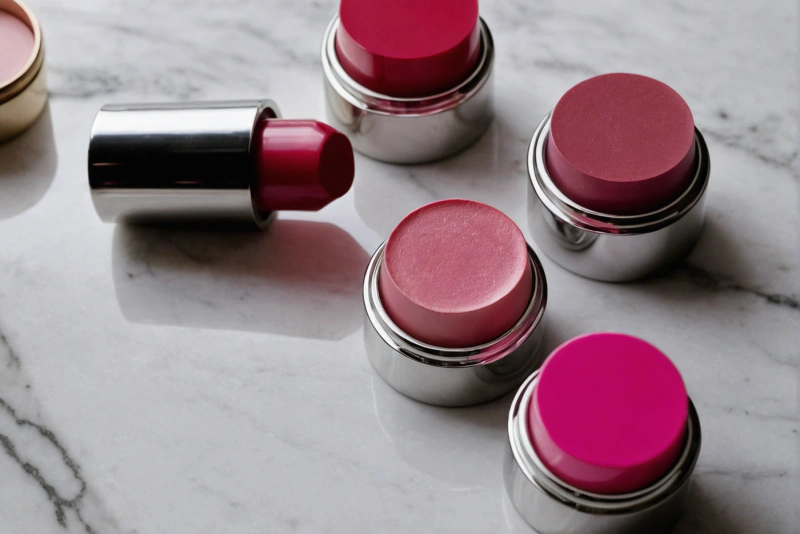
A newer method, IES TM-30, splits colour quality into an average fidelity score (Rf) and an average gamut score (Rg). A Department of Energy tutorial on TM-30 explains that an Rg above 100 means colours come out more saturated than under the reference light and an Rg below 100 means less saturated. Many lighting makers report TM-30 values next to CRI, and an Rg close to 100 points to a lamp that neither drains nor exaggerates colour, which is what a make-up mirror needs.
Colour temperature: match the light the face will be seen in
Correlated colour temperature, in kelvin, describes how warm or cool a lamp's own light looks; the Department of Energy stresses that the figure describes the light itself, not how objects look under it. A 2700 K lamp looks yellowish, and 5000 K looks bluish white.
For make-up the useful question is where the face will be seen. Make-up for an evening at home or in a restaurant can be done under warm light close to that setting, while make-up for an office or for daylight outdoors is better judged under neutral white around 4000 K. A separate article on choosing warm or cool white room by room covers the effect of evening light on sleep, which argues against keeping very cool light in the bedroom late at night.
Two lamps with the same nominal colour temperature can still look different, one slightly green and one slightly pink, because a nominal figure such as 2700 K covers a range of real values. The EU regulation still allows one LED model a colour spread of up to a six-step MacAdam ellipse, and the Department of Energy warns that a nominal colour temperature alone does little to make several lamps look alike. Lamps on either side of one mirror should be the same model, bought together, ideally from the same box.
Direction: why a ceiling downlight is the wrong lamp for a mirror
A single downlight above the mirror lights a face from the top, so the brow casts a shadow over the eyes, the nose over the upper lip and the chin over the neck. The shadows make under-eye circles look darker than they are and hide the jawline, so concealer and contour go on too heavily.
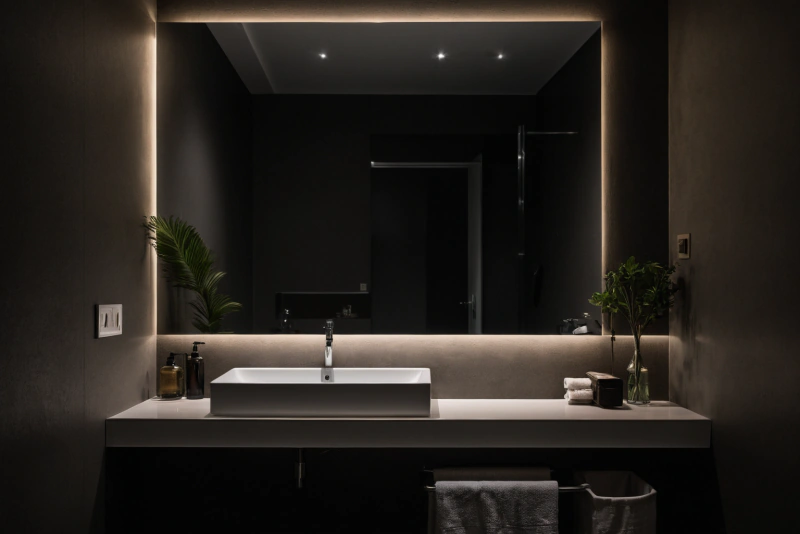
Light from both sides of the mirror at roughly face height fills those shadows evenly, because each lamp lights the half of the face that the other leaves dim. Vertical wall lights or light bars set into both edges of the mirror do the job; a pair of table lamps set either side of the mirror at the same height comes close. A frame of light around the whole mirror works as well, and the top section of such a frame matters less than the sides.
Diffused light is kinder to a face than a bare point of light. An opal or frosted diffuser spreads the light over a larger surface, which softens the edge of any shadow and reduces glare in the mirror itself.
A checklist for buying make-up lamps
The box or the maker's data sheet should answer five questions before a lamp goes up beside a mirror:
- CRI of 90 or above, stated as a figure rather than as "high CRI".
- An R9 value stated on the data sheet, with a higher figure preferred.
- Colour temperature chosen for where the make-up will be seen: warm for evenings, about 4000 K for daytime.
- The same model and batch for every lamp around one mirror, so the two sides match.
- No visible flicker, which matters close to the eyes; the article on LED flicker and how to check a bulb explains a simple test with a phone camera.
A dressing table in a bathroom adds one more condition. Lamps near a basin or shower sit in electrical zones with rules on water protection, set out in the article on bathroom lights, zones and IP ratings. A dressing room adds another concern, the effect of light on stored clothes, covered in the piece on keeping clothes away from light, damp and moths. The products on the table need care of their own in a Gulf summer, set out in the article on keeping cosmetics in heat and humidity.
Sources
- LED Color Characteristics, US Department of Energy, Building Technologies Office
- A Tutorial on Calculating and Interpreting IES TM-30 Colour Rendition Measures (Royer, LEUKOS, 2022), US Department of Energy, Solid-State Lighting programme
- Commission Regulation (EU) 2019/2020 laying down ecodesign requirements for light sources and separate control gears, Official Journal of the European Union