The dressing room: keeping clothes safe from light, damp and moths
Museum conservators protect historic costume from exactly the three things that ruin clothes in a home: light, damp and insect larvae. The same precautions keep colours, fibres and favourite pieces intact in a home dressing room.

A dressing room is a small archive of textiles, and it faces the same three threats as a museum's costume store: light that fades colour, damp that brings mould, and insect larvae that eat wool and silk. The Canadian Conservation Institute, a federal agency that advises museums on the care of collections, publishes detailed guidance on all three, and most of it works in a flat in Dubai as well as in a museum in Ottawa.
Light: keep clothes in the dark when no one is choosing them
Light damage to textiles is cumulative and irreversible, according to the institute's note on textiles and the environment, and it depends on the total dose: the light level multiplied by the hours of exposure. The same note states that storing textiles in closed cabinets or drawers protects them completely from light and ultraviolet radiation.
A dressing room with a window therefore needs either curtains that stay closed or wardrobes with doors. An open rail placed opposite a sunny window is a poor arrangement, because the shoulders of every garment on it take the light day after day. The article on why curtains and sofas fade by the window shows how quickly sensitive dyes fade at the light levels found near glass.
Lamps inside a wardrobe matter less, as long as they are LEDs that switch off with the door. The institute's comparison of light sources rates white LEDs as emitting very little ultraviolet, 0 to 75 microwatts per lumen, against 300 to 600 for typical daylight. A mirror and dressing table in the same room need different light again, with good colour rendering, as the article on light for make-up at a dressing table explains.

Damp: the one condition to avoid every time
The institute singles out damp, above 70 per cent relative humidity, as the one form of incorrect humidity that should always be avoided for textiles. Without damp there can be no mould, no shrinkage of woven materials and less tendency for dust to cement itself to fibres. Dry air has extra benefits: the institute notes that insect attack is much less frequent below 40 per cent relative humidity, which matters especially for wool.
In a UAE flat, damp in a dressing room can come from an adjoining bathroom or from the humid months of June and September. A dressing room that opens straight onto an en-suite should keep the bathroom door closed and the extractor running after every shower, as set out in the article on a bathroom without a window. Make-up and skincare kept in the same room benefit from the dry air too, as the article on where to keep cosmetics in a UAE home explains. The US Environmental Protection Agency recommends keeping indoor humidity below 60 per cent, ideally 30 to 50, and a cheap hygrometer on a shelf shows whether the room stays there. The article on fibres and humidity explains why cotton and wool take up moisture from damp air and synthetics do not.
Moths and carpet beetles: what they eat and where they hide
The damage is done by larvae of the clothes moth and the carpet beetle, not by the adult insects. The institute's textile note explains that the larvae perforate and eat keratin, the protein of wool, and will also attack silk, cotton and synthetics if the fabric is soiled or stands between them and a source of food. Undisturbed, dark places make an ideal habitat, which describes the back of a wardrobe exactly.
The institute lists the signs to look for: the larvae themselves, their webs and casings, which often contain droppings the same colour as the fabric, eggs and adult insects. Clothes that are worn and moved regularly are disturbed too often for larvae to settle; the cashmere jumper folded away since last winter is the one at risk.
Prevention follows from how the larvae live. Clothes go into storage clean, because soiling attracts larvae even to fibres they do not normally eat. Seasonal pieces are taken out, shaken and inspected every few weeks. A new or second-hand woollen piece can be checked before it joins the rest of the wardrobe, the domestic version of the quarantine the institute recommends for anything entering a collection.
Freezing an infested garment
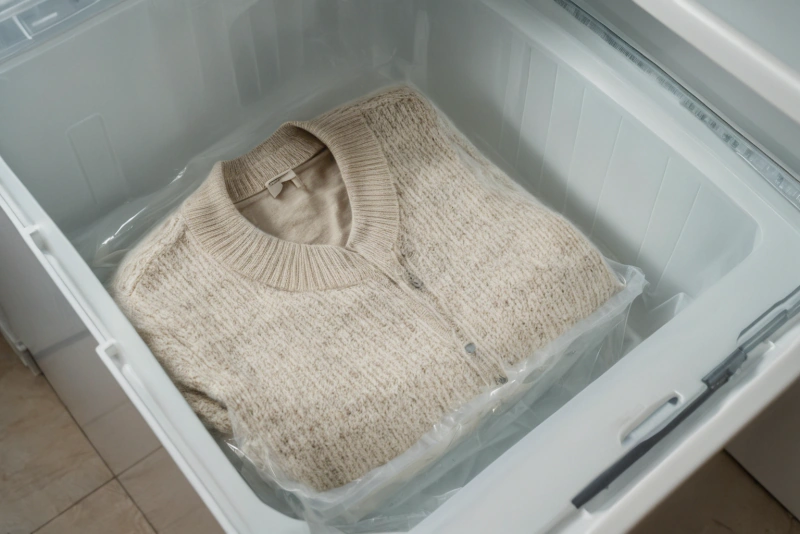
Freezing controls clothes moths without chemicals, and the institute's note on controlling insect pests with low temperature gives a method that works with a household chest freezer. The general rule is to cool the object as low as possible, as quickly as possible, for as long as possible; a practical recommended treatment is -20 °C for one week, and household deep-freezers running between -20 and -25 °C can be very effective.
- Seal the garment in a clear polyethylene bag, closing it well so the air inside is isolated.
- Freeze it at -20 °C or colder for at least a week.
- Take the bag out without opening it and leave it for a day to reach room temperature; any condensation forms on the outside of the bag if the seal is good.
- Keep it sealed for a while longer to check for surviving insects, since eggs and pupae can take three weeks or more to develop.
The institute notes that textiles, furs, feathers and leather are generally not harmed by low temperatures, while rubber and some synthetic polymers such as soft vinyl become brittle when cooled, so a garment with rubber or vinyl trim needs more care.
Sources
- Textiles and the Environment (CCI Notes 13/1), Canadian Conservation Institute, Government of Canada
- Agent of deterioration: light, ultraviolet and infrared, Canadian Conservation Institute, Government of Canada
- Controlling Insect Pests with Low Temperature (CCI Notes 3/3), Canadian Conservation Institute, Government of Canada
- A Brief Guide to Mold, Moisture and Your Home, US Environmental Protection Agency