Warm white or cool white: colour temperature room by room, and what evening light does to sleep
The kelvin figure on a lamp changes how a room looks and, after dark, how soon the body gets ready for sleep. Research on evening light gives a simple rule for a UAE flat: bright and neutral by day, dim and warm for the last three hours before bed.

A lamp's colour temperature decides two things in a home: how the room and everything in it looks, and how much the light tells the body that it is still daytime. The second effect has been measured in laboratories, and in 2022 an international group of sleep and lighting researchers turned the results into targets.
What the kelvin figure on a lamp means
Correlated colour temperature, written in kelvin (K), compares the colour of a lamp's light with the glow of an idealised object heated to that temperature, according to a fact sheet from the US Department of Energy. A low figure such as 2700 K looks yellowish and warm, and a high figure such as 5000 K looks bluish and cool. The figure describes the light itself, not how objects look under it, which is the job of the colour rendering index covered in the article on light for make-up at a dressing table.
The figure on the box is a nominal one. The Department of Energy points out that a designation such as 2700 K covers a range of actual values defined by the American standard ANSI C78.377, so two lamps sold as 2700 K can look slightly different, one greener and one pinker. Lamps meant to light one room together are best bought as the same model.
What evening light does to melatonin
Ordinary room light in the evening delays the hormone that prepares the body for sleep. A study led by Joshua Gooley and published in 2011 in the Journal of Clinical Endocrinology and Metabolism compared 116 healthy volunteers aged 18 to 30 living in room light of under 200 lux with the same people in dim light of under 3 lux during the hours before bedtime.
Room light before bed delayed the onset of melatonin in 99 per cent of the volunteers and shortened the time melatonin was present by about 90 minutes. Room light kept on through the usual hours of sleep suppressed melatonin by more than 50 per cent in 85 per cent of the trials. The paper also points to earlier work in which half of the maximum melatonin response came at about 100 lux, far dimmer than the 350 to 500 lux recommended for offices.
The 2022 recommendations in numbers
A workshop of sleep, circadian and lighting researchers published consensus recommendations in PLOS Biology in 2022, expressed in a measure called melanopic equivalent daylight illuminance (melanopic EDI). The measure weights light by its effect on the eye's melanopsin cells, the receptors that signal light to the body clock, and comes from the international standard CIE S 026:2018.
| Time | Recommended melanopic EDI at the eye |
|---|---|
| Daytime, indoors | At least 250 lux, daylight first |
| Evening, from at least 3 hours before bed | No more than 10 lux |
| Sleep environment | No more than 1 lux |
| Night-time activity that needs some light | No more than 10 lux |
The figures are measured at eye level, vertically, at about 1.2 m from the floor, the height of the eyes of a seated person. The recommendations apply to healthy adults aged 18 to 55 with regular daytime schedules; the authors flag children, older people and shift workers as special cases.
Why warm white makes the evening target easy
Warm white LEDs give less melanopic light for the same brightness, which is the main reason to choose them for evening rooms. The PLOS Biology paper notes that homes in the evening are commonly lit to about 30 lux, and that many domestic warm white LEDs of 2,700 to 3,000 K already meet the 10 lux melanopic target at that brightness, without making a room darker.
The same paper reports that in a study of real homes, evening light was already at or below the target on nearly half of the occasions measured, and that many of the cases above it involved light rich in short, bluish wavelengths. According to the authors, those cases could in principle be brought within the target simply by using lamps with less melanopic output.
The authors add a second point that matters in a flat with tinted glass and drawn curtains: brighter light earlier in the day appears to soften the effect of light in the evening. A bright, daylit morning and a dim, warm evening work together.
A plan for each room
A UAE home can follow the recommendations with a simple plan: neutral white and daylight for the hours of work, and warm, low light after dark.
- Bedroom: warm white of 2700 K or close to it, on a dimmer, with the main ceiling light kept for cleaning and dressing. For sleep the room should be as dark as possible, which is the work of curtains as much as lamps; the article on sheer, dim-out and blackout curtains compares how much light each one stops.
- Living room or majlis: warm white in the evening. Lamps on side tables, or a second circuit, keep the room usable at a lower level after sunset.
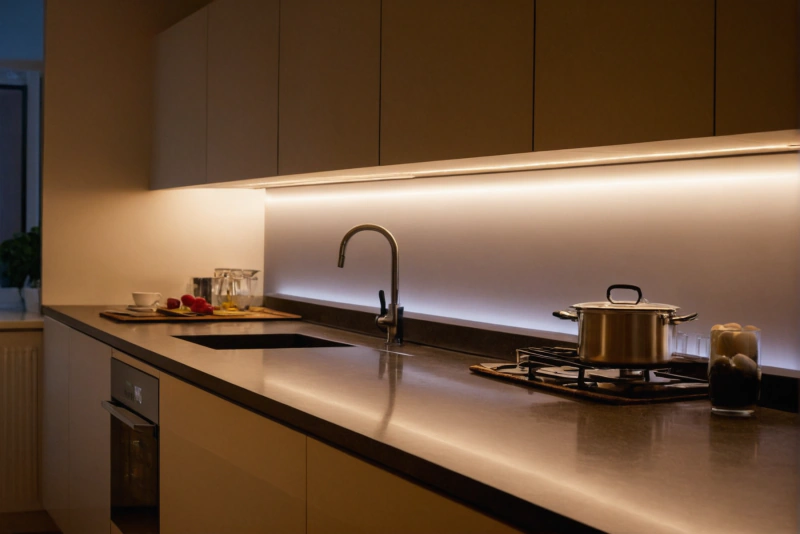
- Kitchen: task lights under the wall cupboards put light on the worktop, so the overall level of the room can stay low in the evening. The PLOS Biology authors suggest task lighting for exactly this purpose.
- Study or home office: daylight first, as the recommendations themselves say, so a desk beside a window is the place to start; in the cooler months the low sun reaches deeper into a room, as the article on December light in UAE flats explains. For lamps used in the day, a neutral white of about 4000 K suits work, because the recommendations favour daytime light with a spectrum closer to daylight.
- Corridor and the route to the bathroom at night: a dim, warm guide light rather than the ceiling light. Older people may need brighter light to move safely at night, a caveat the authors make themselves. The entrance hall has needs of its own, set out in the article on lighting and furnishing the entrance hall.

Tunable lamps, which shift from neutral to warm white, follow the same idea in one fitting: a spectrum richer in short wavelengths by day and poorer in them by evening, which is the direction the recommendations describe. Any lamp used for hours close to the eyes also needs to be free of visible flicker, a separate question dealt with in the article on LED flicker and how to check a bulb.
Sources
- LED Color Characteristics, US Department of Energy, Building Technologies Office
- Exposure to room light before bedtime suppresses melatonin onset and shortens melatonin duration in humans (Gooley and others, 2011), Journal of Clinical Endocrinology and Metabolism
- Recommendations for daytime, evening, and nighttime indoor light exposure to best support physiology, sleep, and wakefulness in healthy adults (Brown and others, 2022), PLOS Biology