Bathroom lights and water: the zones, the IP numbers and Dubai's rules on switches and sockets
A light beside a basin or above a shower sits in the most tightly regulated corner of a home's wiring. The zone system decides how waterproof a fitting must be, and in Dubai the DEWA regulations add rules of their own.

A light fitting near a bath, a shower or a basin has to cope with steam, splashes and wet hands, so the rules for it are stricter than for lamps anywhere else in a home. Two sets of rules matter in Dubai. The zone system of the British wiring regulations, BS 7671, sets how waterproof a fitting must be according to where it hangs, and the Dubai Electricity and Water Authority (DEWA) adds its own requirements for switches, sockets and mirror lights.
The three zones around a bath or shower
BS 7671 divides a room containing a bath or shower into zones 0, 1 and 2, measured from the bath tub or shower tray, according to a pocket guide to Section 701 of BS 7671:2018+A2:2022 published by SELECT, the Scottish electrical contractors' association. Everything beyond those zones, but still inside the room, counts as outside the zones.
| Zone | Where it is | Lights allowed |
|---|---|---|
| 0 | Inside the bath tub or shower tray | Only fixed equipment rated at least IPX7, on a safety extra-low voltage supply of no more than 12 V AC |
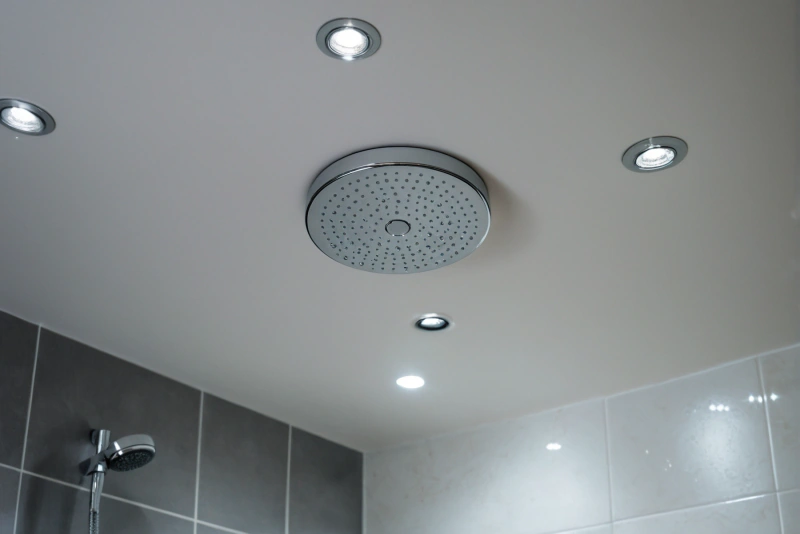
| 1 | Above the tub or tray up to 2.25 m from the floor, or the highest fixed shower head if higher | Fixed, permanently connected fittings rated at least IPX4 |
| 2 | A band 0.6 m wide beyond zone 1, to the same height | Equipment rated at least IPX4 |
A shower without a tray works differently. The SELECT guide describes zone 1 as reaching 1.20 m horizontally from the centre of the fixed water outlet, with no zone 2, so a walk-in shower spreads the strict rules for the area around the water outlet over more of the floor than a shower with a tray. The space under a bath also counts as zone 1 if it can be reached without a tool.
What the IP number on a fitting means
The IP code comes from the international standard IEC 60529, which grades the protection an enclosure gives: the first numeral covers access to live parts and solid objects such as dust, and the second numeral covers water. Bathroom rules quote only the water number, written as IPX4 or IPX7.
IPX4 means protection against splashing from any direction, and IPX7 means protection against temporary immersion, in the wording of the SELECT guide. A fitting marked IP44 states the same water protection as IPX4, with a rating against small solid objects added in front. A fitting with no IP marking at all has no stated water protection and belongs outside the zones.
Where a basin and a vanity mirror fit in
The zones are measured from the bath tub or the shower, not from the basin, so a vanity mirror over a basin on another wall often stands outside the zones altogether. A basin placed within 0.6 m of the edge of a bath tub or shower tray falls inside zone 2, and every fitting above it then needs at least IPX4. A mirror cabinet over the basin can hold creams and make-up as well, and the article on storing cosmetics in heat and humidity explains why spares keep better in a drier room.
Outside the zones the water rules relax, while other protections stay. The SELECT guide states that every low-voltage circuit serving a room with a bath or shower needs additional protection by a residual current device (RCD) with a 30 mA rating. A mirror light that catches splashes from a basin every morning also lasts longer with a splash rating, even where the zone rules do not demand one, and the article on make-up light at a dressing table covers what the light itself should do.
What DEWA adds in Dubai
The DEWA Regulations for Electrical Installations, 2017 edition, apply to installations in the emirate of Dubai, and their introduction says they refer generally to the seventeenth edition of the IET Wiring Regulations, an earlier edition of BS 7671. On several bathroom points DEWA is stricter than the British text.
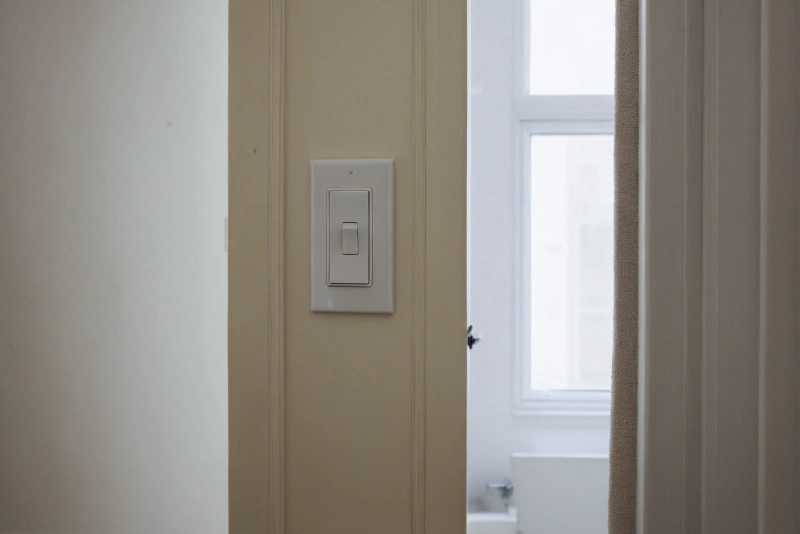
- Switches: switches controlling a light fitting or a water heater shall not be installed in the bathroom, under clause 7.4.1.8, which is why the light switch in most Dubai bathrooms sits outside the door.
- Sockets: socket outlets shall not be installed in bathrooms, under clause 7.4.1.9. BS 7671 allows a socket 2.5 m beyond zone 1 with RCD protection, but DEWA's rule leaves no such allowance.
- Mirror lights and shaver points: mirror lights and shaver socket outlets installed in a bathroom count as extra-low-voltage safety apparatus and need a double-wound safety isolating transformer, built in or mounted separately, under clause 4.6.7.
- Water heaters: the control switch for a water heater in a bathroom goes immediately outside the room, and every heater circuit needs a 30 mA residual current circuit breaker.
DEWA also requires every electrical contractor working in Dubai to enrol with the authority before carrying out installation work. A new mirror light, a moved switch or an extra fitting over a shower is therefore a job for an enrolled contractor, not a weekend project.
A short checklist before changing a bathroom light
Four questions settle most decisions about a bathroom fitting in a Dubai home:
- Is the fitting inside zone 1 or zone 2, measured from the bath or shower? If so, the box must state IPX4 or higher.
- Does a mirror light come with, or call for, a safety isolating transformer, as DEWA requires for bathroom mirror lights?
- Will the switch sit outside the bathroom, as clause 7.4.1.8 requires?
- Is the installer an electrical contractor enrolled with DEWA?
Tenants have one more step. A change to fixed fittings in a rented flat needs the landlord's written consent first, as the article on painting and altering a rented flat in Dubai explains. Steam that lingers after a shower is a separate problem from wiring, and the article on a windowless bathroom, extraction and mould deals with it.
Sources
- Electrical Installations in Locations Containing a Bath or Shower, SELECT, the electrical contractors' association of Scotland
- Regulations for Electrical Installations, 2017 Edition, Dubai Electricity and Water Authority (DEWA)
- ANSI/IEC 60529-2020, Degrees of Protection Provided by Enclosures (IP Code), National Electrical Manufacturers Association (NEMA)