Cotton, linen or polyester when the air turns humid: what fibres do with damp
Natural fibres take water out of the air and synthetics barely touch it. In a coastal UAE flat that difference decides how bedding feels on a sticky September night and how a sofa or a stack of linen copes with damp.

Every textile in a home trades moisture with the air around it, and the amount depends on what the fibre is made of. In the UAE the trade matters most twice a year: Dubai and Abu Dhabi typically get two spells of high humidity, in June and in September, as The National has reported, and the coastal cities feel them more than inland towns because the moisture comes off the warm sea.
How humid the UAE gets
The National reported an average relative humidity of 72 per cent in August and 76 per cent in September. Dr Ahmed Habib of the National Centre of Meteorology explained the reason to the paper: as temperatures fall at night and in the early morning, relative humidity climbs. December is drier on average: the centre's climate summary for the month, reported by the Emirates News Agency, gives a mean of around 63 per cent, although maximum humidity often climbs to between 79 and 90 per cent and moist air from the Gulf brings fog in the early morning.
Indoors, the picture depends on the air conditioning, the bathroom extractor and how often the balcony door stands open. The US Environmental Protection Agency recommends keeping indoor humidity below 60 per cent, ideally between 30 and 50 per cent, to prevent mould, and notes that condensation on windows, walls or pipes is a sign of high humidity.
Natural fibres drink, synthetics do not
Textile scientists measure a fibre's appetite for water as moisture regain: the weight of water a bone-dry fibre takes up from air of a standard humidity, as a percentage of its dry weight. The US National Bureau of Standards described the measure in its early textile testing circular and noted that wool, cotton, silk and linen absorb very different amounts of moisture depending on the fibre.
The American Chemical Society gives typical regain figures for common fibres:
| Fibre | Moisture regain |
|---|---|
| Wool | About 16 per cent |
| Cotton | About 8.5 per cent |
| Cotton and polyester, 50/50 | About 4.45 per cent |
| Nylon | About 4 per cent |
| Polyester | About 0.4 per cent |
Chemistry explains the gap. Cotton is made of cellulose, whose hydroxyl groups attract water molecules strongly, while polyester is petroleum based and, in the ACS's words, quite hydrophobic. Linen, a cellulose fibre like cotton, also takes up moisture from the air.
What that means on a humid night
A fibre that absorbs moisture from the air also absorbs moisture from skin. Cotton and linen sheets draw sweat into the fibre instead of leaving it on the skin, although the ACS article points out that a very hydrophilic fibre such as cotton holds water rather than moving it on, which is why a cotton shirt soaks through on a run. Polyester takes up almost nothing, so moisture stays on the surface, and sportswear makers treat it or weave it with other fibres to make it wick.
For bedding in a UAE bedroom, the practical result is that cotton and linen suit nights when the air conditioning is set gently, while a polyester-rich sheet leaves moisture sitting on the skin, the raincoat effect the ACS article describes. A 50/50 blend sits in between, with roughly half the regain of pure cotton according to the ACS figures.
What humidity does to fabrics in storage and on furniture
In a damp room the same thirst for water has a cost. The Canadian Conservation Institute, which advises museums on textile care, names damp above 70 per cent relative humidity as the one condition to avoid always, because without damp there can be no mould and less tendency for dust to cement itself to fibres. The institute also notes that dry air slows light fading for some dyes, a point covered in the article on why curtains and sofas fade.
The EPA's guidance adds the urgency: wet or damp materials dried within 24 to 48 hours usually do not grow mould, while absorbent materials such as carpet may have to be thrown away once mould takes hold, because it grows into their crevices.

A short guide for the humid months
A handful of habits protects textiles through June and September:
- Bedding: cotton or linen for comfort, changed and washed often, and dried fully before it goes back in the cupboard.
- Upholstery: a fabric that absorbs moisture should not sit against a wall that sweats with condensation. A gap behind the sofa lets air move.
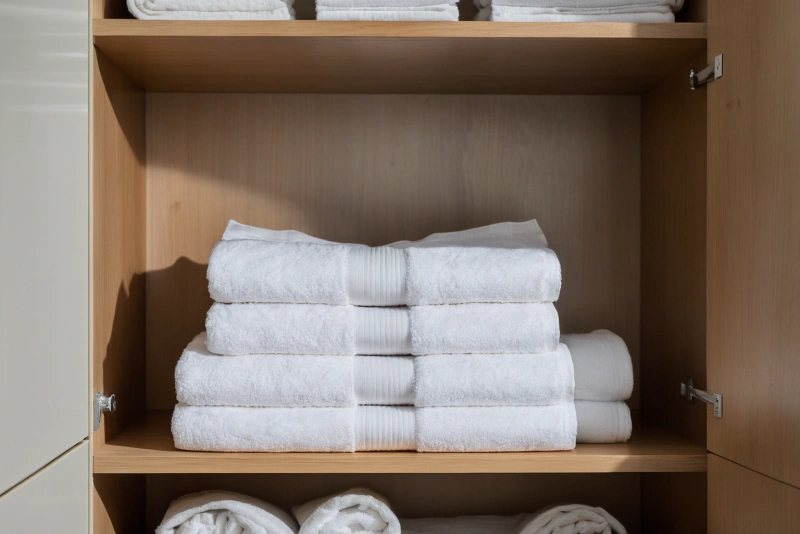
- Storage: folded towels, sheets and clothes need a dry, ventilated cupboard. The article on the dressing room and light, damp and moths covers storage in detail.
- Indoor air: a hygrometer costs little and shows whether a room stays under the EPA's 60 per cent mark. A bathroom without a window is usually the dampest room in a flat, as the article on a windowless bathroom and mould explains.
- Outdoors: fabrics for a balcony face humidity, salt and sun at once and need different fibres altogether, set out in the article on fabrics for the winter balcony.
Sources
- Don't Sweat It: How Moisture-Wicking Fabrics Keep You Cool and Dry, American Chemical Society, inChemistry
- Circular 41: Testing of Textiles (second edition), US National Bureau of Standards (now NIST)
- Why does it feel so much hotter? Humidity in the UAE explained, The National
- UAE records cooler temperatures, higher humidity, increased fog potential in December (3 December 2025), Emirates News Agency (WAM)
- Why is September so humid in the UAE? (14 September 2023), The National
- A Brief Guide to Mold, Moisture and Your Home, US Environmental Protection Agency
- Textiles and the Environment (CCI Notes 13/1), Canadian Conservation Institute, Government of Canada