Sheer, dim-out or blackout: what each curtain does with Gulf sun
A curtain inside a window can soften glare, slow fading, darken a bedroom for sleep and trim some of the cooling bill, but no single fabric does all four.

Curtains in a UAE flat are asked to do four jobs: cut the glare from a wall of glass, keep colours from fading, darken a bedroom for sleep and keep some of the sun's heat away from the air conditioning. A sheer, a dim-out and a blackout curtain each handle some of those jobs well and others badly. Guidance from the Building America Solution Center, run by the Pacific Northwest National Laboratory for the US Department of Energy, explains the trade-offs better than any shop label.
What a curtain inside the glass can and cannot do about heat
An interior curtain stops sunlight only after it has passed through the glass, which limits what it can do about heat. The PNNL guide states that interior attachments can be less effective at reducing heat gain than comparable exterior shading, because it is harder to reflect heat and light back out of a window than to block them before they reach it.
Interior curtains and blinds still help. The guide reports Department of Energy field studies that measured whole-home summer cooling savings of 15 to 25 per cent from the optimised use of high-efficiency shades, inside and outside the window. The optimal strategy for cooling, according to the guide, is simply to close the attachments during the day and open them at night when it is cooler outside than inside. A light, reflective face towards the glass can help a curtain send some of the sunlight back out; the guide's own example of light-filtering pleated blinds credits their cooling savings to blocking and reflecting sunlight.
Sheer curtains: softer light, less glare, slower fading
A sheer lets daylight in but scatters it. The PNNL guide describes sheer shades as very effective for daylighting and glare control while keeping a softened view to the outside, and notes that diffuse daylight carries less waste heat than nearly any electric light.
Sheers also protect what is in the room. The guide lists reduced exposure to ultraviolet radiation, which slows the fading and deterioration of fabrics, furniture and floors, among the benefits of window attachments. The Canadian Conservation Institute adds the more important point for colour: fading of sensitive dyes depends on the total amount of light, not on UV alone, so a sheer that lowers the overall light level protects a sofa better than a UV film on the glass. The article on why curtains and sofas fade by the window explains the measurements behind that rule.
Dim-out and blackout: darkness for sleep
For a bedroom, the target comes from sleep science. A consensus of sleep and circadian researchers published in PLOS Biology in 2022 recommends that the sleep environment be as dark as possible, with no more than 1 lux of melanopic light at the eye, a level close to darkness. Street lighting, a neighbour's balcony lamp or an early summer sunrise can all exceed that through an unlined curtain.
A dim-out curtain cuts most of the light; a blackout curtain, usually a fabric with an opaque lining or coating, cuts nearly all of it through the cloth itself. The PNNL guide lists reduced night-time light intrusion for better sleeping conditions among the benefits of window attachments. Light that still reaches a bed usually comes round the curtain rather than through it, so the fitting matters as much as the fabric: a track fixed to the ceiling or high above the frame, panels wide enough to overlap in the middle and returns that wrap round to the wall at the sides.
Two layers on one window
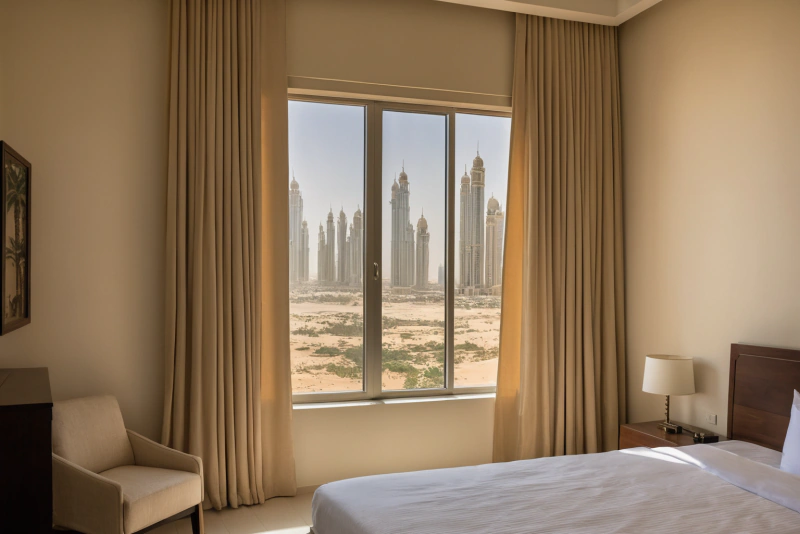
The most flexible arrangement in a room that needs both daylight and darkness is a double track: a sheer on the inner track for daytime and a lined curtain on the outer track for night. The sheer handles glare and fading during the day, and the heavier curtain handles sleep, privacy and the hottest hours of afternoon sun on a west-facing window.

The colour temperature of the lamps used once the curtains are closed also affects sleep, as the article on warm and cool white light room by room explains.
Ratings to look for
Curtains are mostly sold on looks, but some window attachments carry independent energy ratings. The Attachments Energy Rating Council (AERC), an American rating body, labels tested products with performance ratings for warm and cool climates and reports their solar heat gain coefficient, visible transmittance, U-factor and air leakage, according to the PNNL guide. Where a product carries an AERC label, the warm-climate rating is the one that matters in the UAE.
Where the sun comes from matters through the year
West-facing windows take the low, hot afternoon sun, and vertical curtains handle it better than overhangs, because, as the PNNL guide puts it, sunlight cannot bypass a vertical attachment whatever its angle. The angle changes with the seasons, and the low winter sun reaches much deeper into a room than the high summer sun, a change set out in the article on December light in UAE flats. Light and shade were also central to the public installations at the 2026 Dubai Design Week, covered in the article on what the festival said about light, shade and colour.
Sources
- Window Attachments: Solar Control and Energy Efficiency (Building America Solution Center), Pacific Northwest National Laboratory for the US Department of Energy
- Recommendations for daytime, evening, and nighttime indoor light exposure to best support physiology, sleep, and wakefulness in healthy adults (Brown and others, 2022), PLOS Biology
- Agent of deterioration: light, ultraviolet and infrared, Canadian Conservation Institute, Government of Canada
- Attachments Energy Rating Council (AERC), Attachments Energy Rating Council