A bathroom without a window: extraction, paint and stopping mould
In a bathroom with no window, every shower leaves its steam behind unless a fan takes it away. A fan of the right strength, left running for an hour, keeps the grout free of black spots.

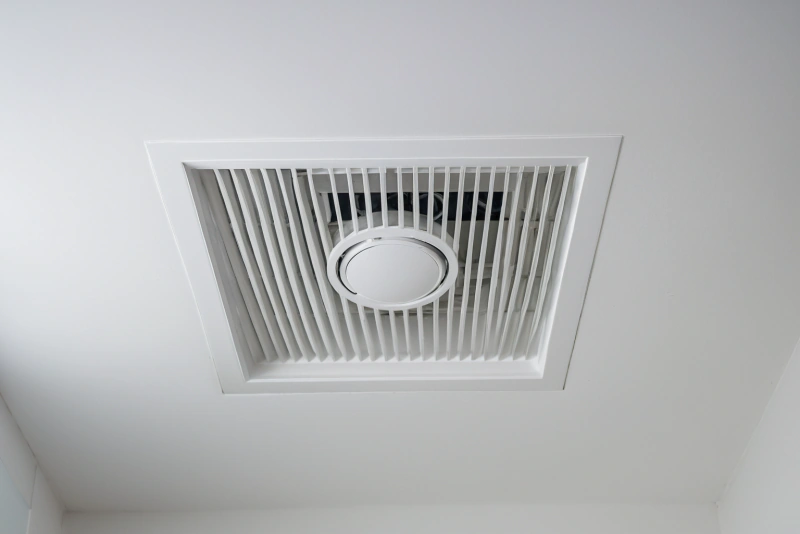
A bathroom without a window depends on one device to get rid of the steam from every shower: the extractor fan. When the fan is too weak, switched off too early or not working at all, moisture settles on the coldest surfaces, soaks into grout and paint, and mould follows.
Why damp in a bathroom matters for health
The World Health Organization's first guidelines on indoor air quality, published by its European office in 2009, dealt with dampness and mould. In announcing them, the WHO said the authors concluded that occupants of damp or mouldy buildings have up to a 75 per cent greater risk of respiratory symptoms and asthma, and that in damp conditions hundreds of species of bacteria and fungi grow indoors and release spores, cell fragments and chemicals into the air.
The WHO's recommendation is prevention: avoid persistent dampness and the growth of microbes on surfaces and inside building structures in the first place. In a bathroom, prevention means removing the steam quickly and letting surfaces dry between showers. Steam also shortens the life of creams and make-up kept in a bathroom cabinet, as the article on cosmetics in UAE heat and humidity explains.
How strong an extractor fan should be
The Building America Solution Center, run by the Pacific Northwest National Laboratory for the US Department of Energy, summarises the requirements of the American ventilation standard ASHRAE 62.2 and the International Residential Code. A bathroom fan should move at least 50 cubic feet per minute (about 24 litres per second) when run on demand, or at least 20 cubic feet per minute (about 9 litres per second) when run continuously.
Because a fan's real airflow once installed may fall short of its rating, ENERGY STAR advises choosing a fan rated well above the minimum. For continuous running at 20 cubic feet per minute, ENERGY STAR recommends a fan rated at more than 50. Duct runs should be as straight as possible, with two to three feet of straight duct before the first bend, and the fan must vent outdoors rather than into a ceiling void.
Noise often decides whether a fan gets used at all. ASHRAE 62.2 requires a sound rating of 3 sones or less for a fan switched on and off by the occupant, and 1 sone or less for a fan that runs continuously, according to the guide.
How long the fan should run
The Building America guide recommends leaving a bathroom fan running for one hour after a shower for effective humidity control, and suggests a timer switch rather than an ordinary wall switch, so that the fan switches itself off after the set time. A fan wired to the light stops when the last person leaves, so it runs for minutes rather than the hour the guide recommends.
Some fans run continuously at a low speed and switch to a higher speed when a motion sensor detects someone in the room, which takes the decision out of the occupant's hands altogether. In a flat, the fan also has to cope with the humidity of the outside air: the article on cotton, linen and polyester in humid months gives the humidity figures for August, September and December.
Paint and colour in a room that gets wet
Paint belongs on clean, dry walls only. The US Environmental Protection Agency advises against painting or caulking over mouldy surfaces: the mould should be cleaned off and the surface dried first, because paint applied over mould is likely to peel. Damp patches that keep returning point to a ventilation problem that paint cannot fix.
Colour has a practical side in a windowless room, where all the light comes from lamps. Pale surfaces with a high light reflectance value, the measure of how much light a surface returns on a scale from 0 to 100, bounce more of the lamp light around the room, so the same fittings light it more evenly. Light from the sides of the mirror matters more than light from above for anyone using the bathroom mirror for make-up or shaving, a point set out in the article on light for make-up at a dressing table. Lamps near the shower must also meet the water-protection rules described in the article on bathroom lights, zones and IP ratings.
A short routine against bathroom mould
Five habits keep a windowless bathroom dry:
- Run the extractor during every shower and for an hour afterwards, ideally on a timer.
- Check that the fan actually pulls air: a sheet of toilet paper held to the grille should be drawn against it.
- Wipe or squeegee water off the shower screen and tiles, so surfaces dry faster.
- Dry any leak or spill within 24 to 48 hours, the window within which the EPA says mould usually does not grow.
- Keep indoor humidity below 60 per cent, ideally 30 to 50 per cent, the range the EPA recommends.
A tenant who finds that the fan does not work should report it to the landlord rather than fit a new one, since electrical work in Dubai needs a contractor enrolled with DEWA, as the article on bathroom lights explains, and any choice of new paint is covered in the article on low-VOC paint in Dubai.
Sources
- Bathroom Exhaust Fans (Building America Solution Center), Pacific Northwest National Laboratory for the US Department of Energy
- WHO publishes first indoor air quality guidelines on dampness and mould (16 July 2009), World Health Organization, Regional Office for Europe
- A Brief Guide to Mold, Moisture and Your Home, US Environmental Protection Agency
- Light reflectance value (LRV) testing and BS 8300-2:2018, SATRA Technology