December light: why the low winter sun reaches deep into UAE flats
At noon in June the sun stands almost overhead in Dubai; at the December solstice it is less than halfway up the sky. The change sends direct sun metres into rooms that stay shaded all summer, with effects on fabrics, plants, screens and the evening lamps.

Winter begins astronomically in the UAE with the solstice on Tuesday 22 December 2026, Gulf News reports, and the National Centre of Meteorology notes that temperatures fall noticeably around that date. The same weeks also change the light inside every flat and villa. The sun stays low enough all day for its rays to cross rooms that see no direct sun in summer, and a sofa, a rug or a houseplant that sat in shade since April can find itself in a bright patch for hours.
How high the sun climbs over Dubai through the year
Dubai lies at latitude 25.2° north. Through the year the sun's path over the city changes like this (UAE time):
| Date | Sun at solar noon | Sunrise and sunset | Length of day | Where the sun rises and sets |
|---|---|---|---|---|
| 21 June 2026 | 88° above the horizon, due south | 05:30 and 19:12 | 13 h 42 min | North of east and north of west |
| 23 September 2026 | 65°, due south | 06:08 and 18:15 | 12 h 07 min | Due east and due west |
| 22 December 2026 | 41°, due south | 07:00 and 17:34 | 10 h 34 min | South of east and south of west |
Dubai lies just north of the Tropic of Cancer, so the midday sun is always to the south, though in June it is only two degrees short of directly overhead. In December it reaches less than halfway up the sky.
How far direct sun reaches into a room
The depth that sunlight reaches on the floor depends on the height of the top of the window and the angle of the sun. For a south-facing window whose top edge is 2.4 m above the floor, the direct sun at noon reaches about 2.7 m into the room on 22 December, about 1.1 m at the September equinox, and less than 10 cm at the June solstice. The same geometry applies to every hour of the day: a lower sun throws its light further.
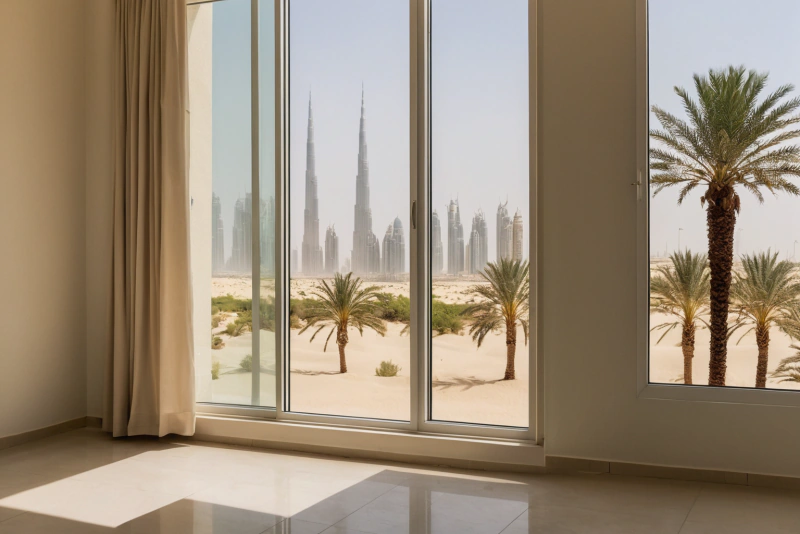
East and west windows see the same effect in the morning and afternoon. On 22 December the sun at 3 pm stands about 27° above the horizon in the south-west, and at 4 pm about 17°, low enough to shine across the full depth of most living rooms. In June the sun at 3 pm is still about 54° up and well to the west, so a west window gets steeper, shorter patches of light.
North-facing rooms work the other way round. In June the sun rises north of east and sets north of west, so north windows catch some low direct sun early and late in summer, and in December they get none.
What the winter sun does to a home
The new patches of sun bring benefits and a few risks:
- Fabrics fade where the sun now falls. A sofa or rug that was safe all summer can sit in direct sun for hours a day in December, and the article on why curtains and sofas fade explains how quickly sensitive dyes change at daylight levels. Turning cushions and moving a rug a little spreads the dose.
- Plants get more light. A plant that struggled through the summer a few metres from a south window may get real sun again, as the article on houseplants and the light they really get shows. The reverse happens in spring.
- Walls change colour. Low, warm afternoon sun across a white wall makes it look warmer, and the article on white walls in strong Gulf light covers testing paint in the light it actually receives.
- Screens and desks catch glare. A television or a desk that faces a south or west window may need a sheer curtain drawn in the afternoons from November to February.
Shorter days, longer evenings under lamps
Sunset in Dubai moves from 19:12 in late June to 17:34 at the December solstice, so the lamps go on more than an hour and a half earlier. The evening under artificial light is correspondingly longer, which makes the colour temperature of those lamps matter more; the article on warm and cool white room by room explains what evening light does to sleep and how to light the hours before bed.
The cooler days also bring the balcony back into use. The National Centre of Meteorology's December summary gives mean daytime highs of 21.7 to 27.4 °C, and the article on cushions and shades for the winter balcony covers the textiles that cope with December dew and sun.
Sources
- NOAA Solar Calculator: solar calculation details, US National Oceanic and Atmospheric Administration, Global Monitoring Laboratory
- UAE winter 2026: When it officially starts and what to do this season, Gulf News
- UAE records cooler temperatures, higher humidity, increased fog potential in December (3 December 2025), Emirates News Agency (WAM), reporting the National Centre of Meteorology climate summary