Houseplants in an air-conditioned flat: measuring the light they really get
A corner that looks bright to the eye can give a plant a tenth of the light it needs. A cheap light meter, or even a phone, shows how much light each spot in a flat really gets.

Light is the first thing to check when a houseplant struggles in a flat, because people are poor judges of brightness. The University of Florida's horticultural extension service puts it bluntly: the human eye adjusts so well that a desk by a window can be ten times brighter than a workspace across the hall and still look only slightly brighter. A plant gets no such adjustment. The same adjustment makes an entrance hall look dark to anyone coming in from the sun, a point taken up in the article on the entrance hall in a Dubai home.
Light levels houseplants need
Extension services in the United States measure plant light in foot-candles, an old unit equal to about 10.8 lux. The University of Florida, whose latitude is close to the UAE's, groups indoor positions by their light at midday:
| Light level | Foot-candles at midday | About in lux | Typical position |
|---|---|---|---|
| Low | 25 to 100 | 270 to 1,080 | Far from windows or lit mainly by ceiling lights |
| Medium | 100 to 500 | 1,080 to 5,400 | Near a window, no direct sun |
| High | 500 to 1,000 | 5,400 to 10,800 | Near a window, some softened direct sun |
| Direct sun | Over 1,000 | Over 10,800 | Directly in front of clear glass |
Thresholds differ between universities, and the University of Minnesota sets its own ranges higher, with medium light between 250 and 1,000 foot-candles. The terms describe the light a position receives, so a plant's label of "low light" or "bright indirect light" only becomes useful once the position has been measured.
The Florida guide gives a sense of scale: even in winter the light outdoors at noon can exceed 4,000 foot-candles, a north-facing window may never reach 400, and an office lit only by fluorescent tubes often has 40 or less.
How to measure the light in a flat
A handheld digital light meter reading in foot-candles or lux is the best tool, according to the Florida guide, and an expensive research or photographic model is not needed. Phone apps can also measure light, with accuracy that varies between devices; the guide describes them as good enough to show changes in light level and suitable for approximate readings.
The useful method is to measure at midday at the height of the leaves, in each spot where a plant might stand, and to repeat the readings in another season. Light changes with the direction of the window, the weather and the time of year, as the guide notes, and window films, sheer curtains and blinds all reduce what reaches the room.
Which windows give which light in the UAE
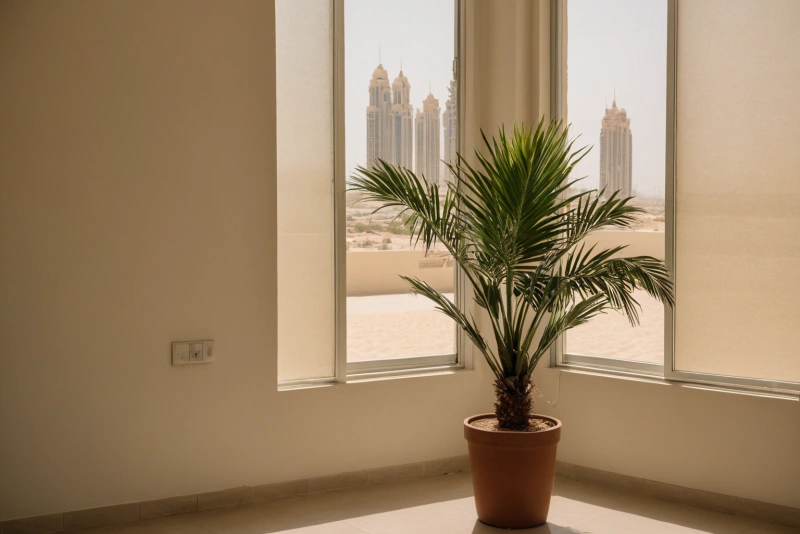
At UAE latitudes the midday sun stands to the south for most of the year, so south and south-west windows give the strongest light and north windows the softest. The University of Minnesota describes an unobstructed south-facing window as the brightest natural position and suggests east windows, or spots near a west window out of direct sun, for medium-light plants.
Distance from the glass matters as much as direction. Colorado State University's extension service gives examples from its own latitude: high light within two feet of south-facing glass in the cooler half of the year and within two feet of east or west glass all year, but only low light six to ten feet back from a south window, or one foot to the side of it, in summer. A metre or two from the glass can move a plant down a whole category.
The season changes the picture in a UAE flat more than many residents expect. The low winter sun reaches deep into rooms that see no direct sun in summer, as the article on December light in UAE flats explains, and a plant that thrives in December may be in shade by May.
Signs that a plant lacks light
The University of Minnesota lists the symptoms: without enough light, plants produce less chlorophyll and turn pale green, yellow or even white, and their stems become "leggy", long and thin, reaching towards the light. A plant leaning hard towards the window is telling the same story.
When daylight is not enough
In dim rooms, grow lights fill the gap. The Florida guide names fluorescent tubes and LEDs as the best options and notes that incandescent bulbs are hot, short-lived and expensive to run for the eight or more hours most plants need. For grow lights, lamps labelled "cool white" work well, and "warm white" and "daylight" may also work, according to the guide. A lamp used for plants in a living room still adds light to the evening, which is worth keeping in mind given the research on evening light and sleep covered in the article on warm and cool white light room by room.
Sheer curtains that protect a sofa from fading also cut the light a plant behind them receives, a trade-off set out in the article on sheer, dim-out and blackout curtains.
Sources
- Light for Houseplants, University of Florida, Institute of Food and Agricultural Sciences (UF/IFAS) Gardening Solutions
- Light requirements for houseplants, University of Minnesota Extension
- Interior Plants: Light (PlantTalk Colorado 1352), Colorado State University Extension