Do light walls make a room look bigger? What the experiments found
Decorating advice says a pale ceiling lifts a room and contrast does the work. Psychologists at the University of Mainz tested the rules in full-scale virtual rooms and found that half of the folk wisdom holds and half does not.

Rules about colour and room size are among the most repeated in home decorating: paint the ceiling lighter than the walls to lift it, keep a small room pale, use contrast to stretch a space. A research group at Johannes Gutenberg University Mainz in Germany tested those rules over several years, using full-scale virtual rooms in which only the lightness of one surface changed at a time. The results back the core of the advice and contradict one of its favourite explanations.
How the experiments worked
Testing paint colours in real rooms makes it impossible to change one surface without changing everything else, so the researchers built virtual rooms instead. In the 2010 study by Daniel Oberfeld, Heiko Hecht and Matthias Gamer, observers judged the height of stereoscopic virtual rooms whose physical height varied between 2.9 and 3.1 m and whose ceiling, wall and floor lightness changed independently of each other.
A 2018 follow-up in PLOS ONE by Christoph von Castell, Heiko Hecht and Daniel Oberfeld used a head-mounted display to show full-scale rooms of about 4.5 by 6 m with a 2.9 m ceiling, and asked 20 observers to estimate width and depth in metres and centimetres while the lightness of the side walls, end wall and ceiling changed independently.
What makes a room look higher
A lighter ceiling made rooms look higher, just as decorators expect. The 2010 study found that lighter walls also made rooms look higher, and that the two effects simply added up: a light ceiling over light walls gave the tallest-looking room.
The floor hardly mattered. A second experiment in the same study showed no significant effect of floor lightness on perceived height, and showed that the total brightness of the room was not the deciding factor either. A pale ceiling and pale walls above a dark wooden or stone floor therefore keep the height gain while the floor stays practical.
The contrast rule does not hold
The popular explanation for a "lifted" ceiling is contrast: a ceiling lighter than its walls is supposed to rise. The 2011 paper by Oberfeld and Hecht in the journal Human Factors tested that idea with a survey of architectural experts and non-experts and with two experiments in virtual rooms.
Both groups in the survey wrongly assumed that the contrast between ceiling and walls changes perceived height. The experiments showed that contrast does not determine how high a room looks, while the lightness of ceiling and walls each adds to it. The authors' conclusion is plain: light ceilings and light walls make a room appear higher, and floor colour has a weaker effect. The paper adds that aesthetic preferences may get in the way of experts' judgement of what colour actually does.
Width and depth follow the surface that bounds them
The 2018 study extended the work from height to width and depth. A bright end wall made a room look deeper, and bright side walls made it look wider, compared with dark paint on the same surfaces. The authors report a medium effect for depth and a strong one for width.
Neighbouring surfaces mattered much less. The study found the effect of a wall's lightness to be mostly independent of the lightness around it, with one exception: bright side walls softened the shortening effect of a dark end wall.
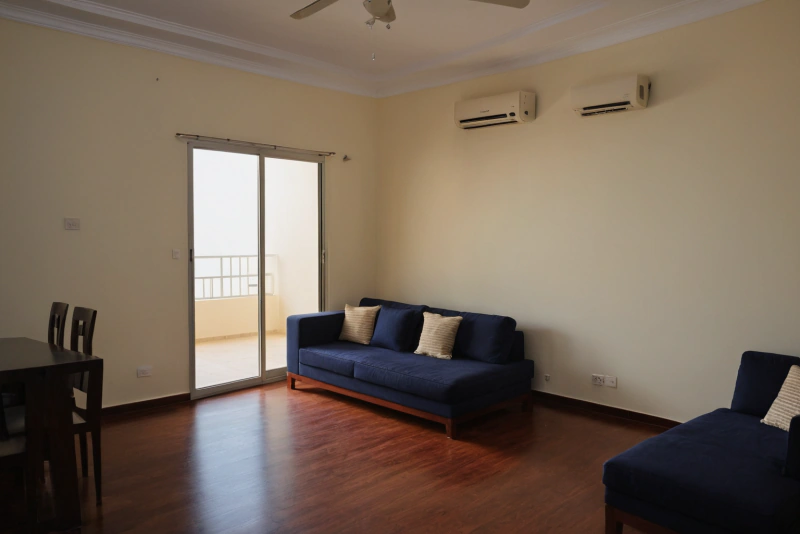
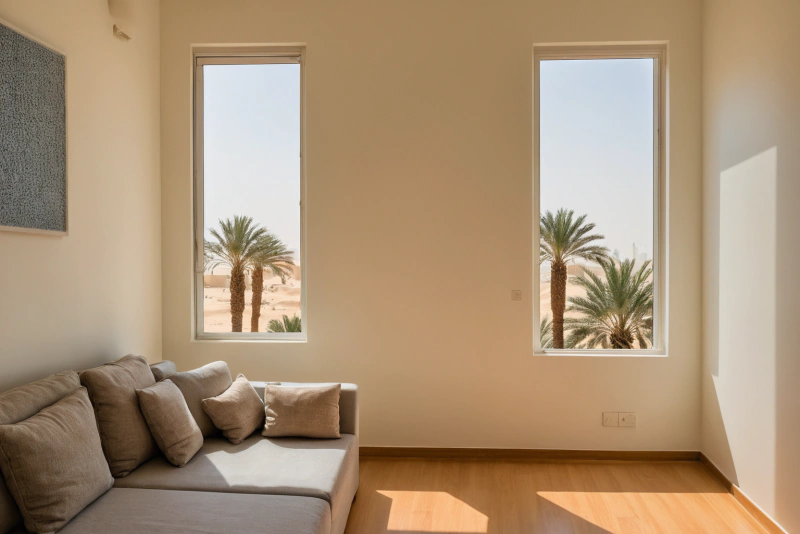
What the findings mean in a UAE flat
To make a low room look higher, keep both the ceiling and the walls light; the floor can be dark. To make a narrow room look wider, keep the side walls light. The same applies to a narrow entrance hall, where a door that contrasts with its pale walls also stays easy to find, as the article on the entrance hall and what greets a guest at the door explains. A dark feature wall at the end of a long room will make the room look shorter, which can be the intention in a corridor-like living room, but it works against anyone trying to make a small flat feel larger.
Two limits apply. The experiments used minimal, unfurnished, windowless virtual rooms, and the 2018 authors acknowledge that real rooms with furniture, windows and daylight may behave differently. And "light" in these studies means lightness, not whiteness: the 2018 paper notes that earlier work found bright ceilings looked higher whatever their hue or saturation, so a pale sand or soft grey can do the job of white. The article on Cloud Dancer and white walls in strong Gulf light covers how pale colours behave in the sun, and the piece on warm and cool white light covers the lamps that light them after dark.
Before a roller touches a wall in a rented flat, the landlord's consent comes first, as the article on painting a rented flat in Dubai explains, and the article on low-VOC paint in Dubai covers what to look for on the tin.
Sources
- Surface lightness influences perceived room height (Oberfeld, Hecht and Gamer, 2010), Quarterly Journal of Experimental Psychology
- Fashion versus perception: the impact of surface lightness on the perceived dimensions of interior space (Oberfeld and Hecht, 2011), Human Factors
- Effects of surface luminance on the perceived width and depth of interior spaces (2018), PLOS ONE