Limewash in a hot, humid city: what heritage guides say about the chalky finish
Limewash gives walls a soft, cloudy finish that acrylic paint cannot copy, and it behaves very differently. Conservation guides from Australia and the United States explain how it cures, why heat ruins it, and why many tins sold as limewash are something else.

Limewash is one of the oldest wall finishes in use: slaked lime stirred into water and brushed on in thin coats. The finished surface is flat, chalky and faintly cloudy, a look that acrylic paint only imitates, and in use it behaves nothing like the acrylic paint on most UAE walls. Two public heritage bodies, Heritage NSW in Australia and the National Park Service in the United States, publish practical guidance that answers most questions about using it in a hot, humid climate.
What limewash is, chemically
Limewash in its basic form is a mixture of water and slaked lime, also called lime putty, hydrated lime or non-hydraulic lime, according to Heritage NSW's maintenance guide. Limewash without pigment is called whitewash. The guide describes the result as "a luminous, robust, flat chalky finish" for walls and ceilings, inside or out.
The finish works through what conservators call the lime cycle. Lime starts as calcium carbonate in limestone, shell, chalk or coral, is burnt into quicklime, slaked with water into calcium hydroxide, and then, once on the wall, slowly absorbs carbon dioxide from the air and turns back into calcium carbonate. The last step, carbonation, is what hardens the coat. In Dubai's old quarters builders worked with local materials: the Dubai Culture and Arts Authority lists stone, gypsum, teak, sandalwood and palm fronds among the traditional building materials of the Al Fahidi Historical Neighbourhood.
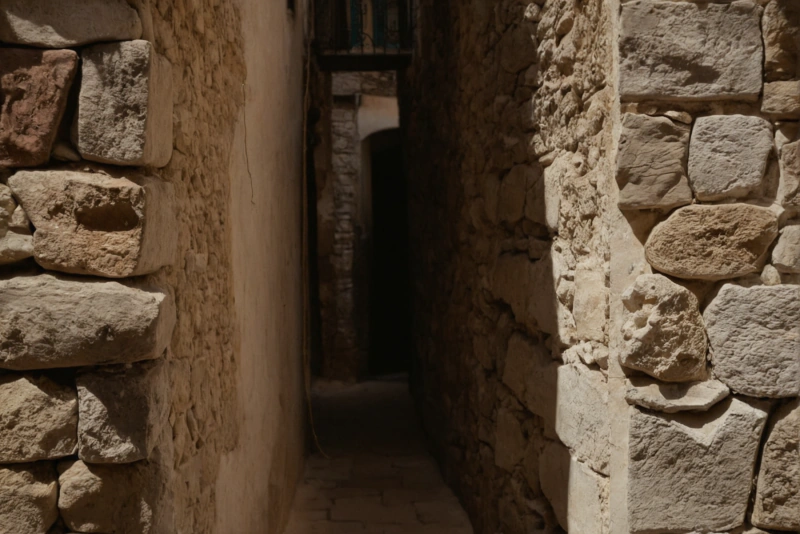
Why a wall finished in limewash "breathes"
Traditional limewash lets moisture pass through it more freely than any other common coating, according to Heritage NSW, which calls its "breathing" capacity the highest of all common coating materials. The guide explains why that matters for old masonry: walls can hold soluble salts that attract water in humid weather, and porous walls exchange air as they warm and cool. A coating that seals the surface traps that moisture inside, and the guide warns that old walls should never be coated with water repellents or other sealing products.
The guidance is written for old masonry. A modern flat with block walls, cement plaster and acrylic paint is built differently, so in a flat the appeal of limewash is mostly its look, and the practical question is whether it will hold.
Many products sold as limewash are not limewash
Heritage NSW warns that the word "limewash" is often used for commercial paints that only imitate its appearance. Many buyers believe they are getting a traditional product, the guide says, when the tin contains materials such as acrylic resins without the breathing qualities of lime.
The guide suggests reading the material safety data sheet, which makers must supply, to see which binder a product uses. A product advertised as an "improved version" of limewash usually contains modern binders, and where one is chosen anyway, the guide recommends a product with the smallest proportion of acrylic or other organic resin.
Why heat is the enemy of a limewash coat
Limewash fails when it dries too fast. The National Park Service study of traditional and modified limewashes reports that the surface was brushed and then dampened before application, because a coat that dried too quickly would not carbonate properly and would leave "a weak, cohesionless finish that tended to crack and powder".
The same study notes that limewash was traditionally applied in spring or autumn to take advantage of mild temperatures, in thin layers with a wet edge kept at all times, and that drying times between coats were 24 hours or longer depending on humidity and temperature. A fresh coat looked transparent at first and became opaque as it carbonated and the layers built up.
For a UAE home, the guidance points to the cooler months of the winter season, to rooms out of direct sun while the coats cure, and to patience between coats. Air conditioning blowing straight at a freshly limewashed wall dries it in the way the study warns against.
Additives, pigments and what they change
Traditional recipes added other ingredients, each of which changes how the finish behaves. Heritage NSW describes three common variants:
- Tallow limewash contains rendered animal fat, is less porous and sheds water better, and can brush off onto clothes. The National Park Service study found that tallow improved water shedding but reduced breathability and made later coats harder to apply.
- Casein limewash, made with a milk protein, is popular indoors and binds well, but is susceptible to mould in its wet form, so a biocide is often added.
- Hydraulic limewash sets by chemical reaction rather than by drying and carbonation, which Heritage NSW describes as useful in wet conditions.
Pigments must resist alkali, because lime destroys many organic pigments; natural earth pigments are the traditional choice. Heritage NSW adds that limewash looks darker in the bucket than on the wall, and suggests small test samples to find the right amount of pigment. Testing on the wall itself, in its own light, matters as much here as with any paint, a point made in the article on white walls in strong Gulf light.
Is limewash right for a bathroom or a rented flat?
Limewash suits dry, airy rooms better than wet ones. The casein type needs a biocide against mould, and some limewashes brush off onto clothes; a bathroom without a window is a poor place for it, as the article on a windowless bathroom and mould explains. In a rented flat, any change of wall finish needs the landlord's written consent first, as the article on painting a rented flat in Dubai sets out.
Where the aim is low emissions rather than a particular look, a certified water-based paint is the simpler route, and the article on low-VOC paint in Dubai explains what the municipality's limits cover. The best months for any finish that needs slow curing coincide with the season of low sun, covered in the article on December light in UAE flats.
Sources
- The maintenance series 7.3: Limewash (2021), Heritage NSW, New South Wales Government
- Durability of Traditional and Modified Limewashes (Jackson, Botting and Striegel), US National Park Service, National Center for Preservation Technology and Training
- Al Fahidi Historical Neighbourhood, Dubai Culture and Arts Authority